Crude Oil: Why Nifty and Bank Nifty React Differently
On this page 7 sections
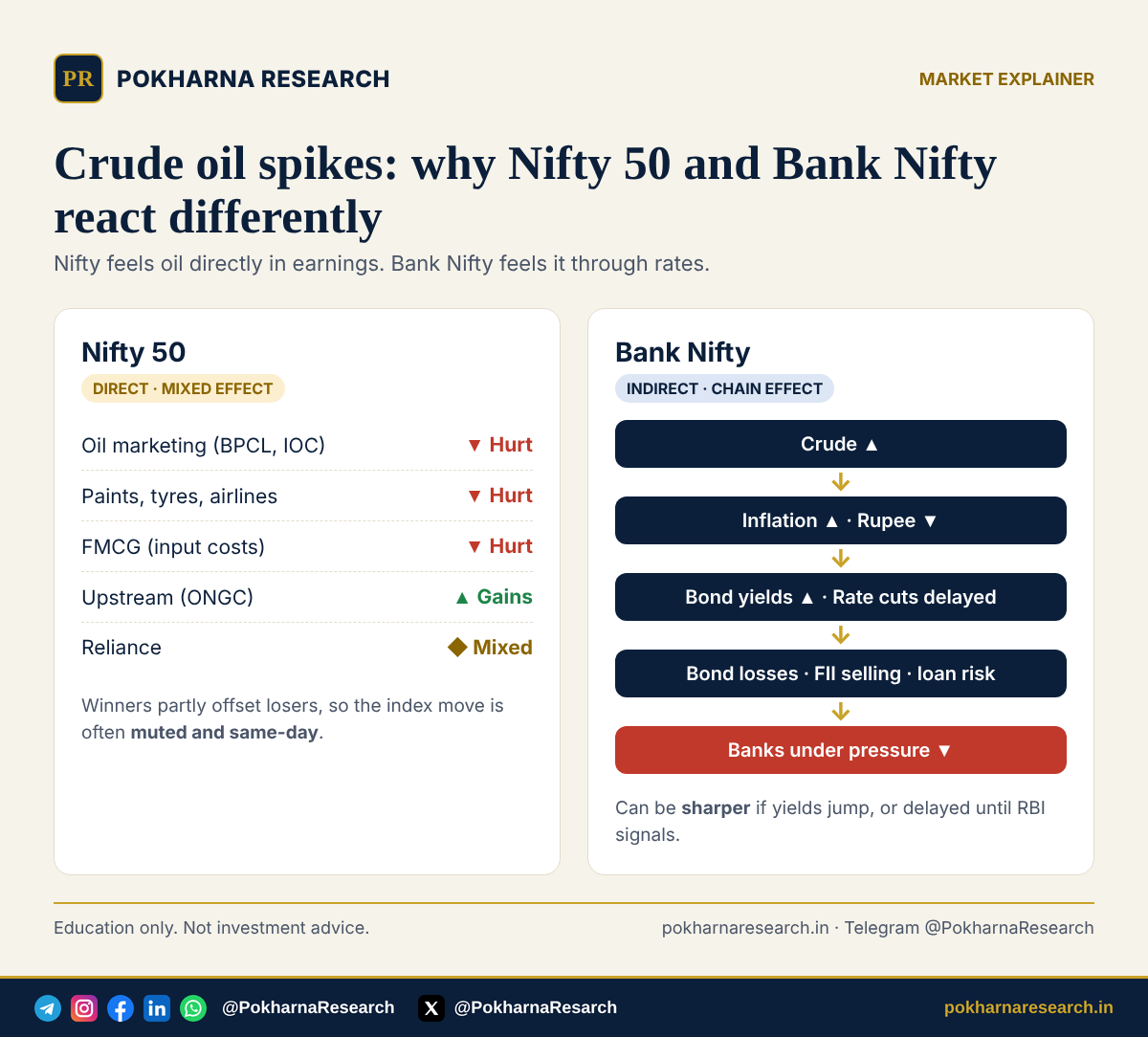
In short: Nifty 50 feels crude oil directly, through the earnings of oil-sensitive companies, and those effects partly cancel out. Bank Nifty has almost no oil companies, so it feels crude indirectly, through a chain: crude → inflation and the rupee → bond yields and RBI rates → bank profits and foreign flows. That is why the two indices can react with different strength and at different speeds to the same oil move.
Why crude matters so much for India
India imports most of the crude oil it uses, more than 80% by most estimates. So when crude moves sharply, it changes:
- Company costs: fuel, freight, packaging and chemical inputs
- Inflation: fuel and transport feed into almost everything
- The rupee: a bigger oil bill means more dollars needed, which weakens the rupee
- Government finances: subsidies and fuel taxes
Each index picks up these effects in a different way.
Nifty 50: direct and mixed effect
Nifty 50 contains companies on both sides of an oil move.
| Sector / company | When crude rises | Why |
|---|---|---|
| Oil marketing (BPCL, IOC) | ▼ Hurt | Cannot always pass on higher costs at the pump |
| Paints, tyres | ▼ Hurt | Key raw materials come from crude |
| Airlines, logistics | ▼ Hurt | Fuel is the biggest cost |
| FMCG | ▼ Hurt | Packaging and transport costs rise |
| Upstream (ONGC) | ▲ Gains | Sells crude at a higher price |
| Reliance | ◆ Mixed | Refining margins, petrochemicals and retail move differently |
Because winners partly offset losers, the Nifty's reaction is often muted and shows up on the same day, through earnings expectations.
Bank Nifty: indirect, chain effect
Banks don't buy much oil. But a crude spike reaches them through four channels.
1. Inflation and RBI rates
Higher crude pushes up inflation. When inflation rises, the RBI is less likely to cut interest rates, or may even stay tighter for longer. Banks' loan growth and borrowers' ability to repay both depend on the rate cycle.
2. Bond yields and treasury losses
Banks hold large amounts of government bonds. When inflation fears rise, bond yields rise and bond prices fall. That creates mark-to-market losses on the banks' bond holdings. PSU banks, which usually hold more bonds relative to their size, tend to feel this more.
3. The rupee and foreign investors
A bigger oil import bill weakens the rupee. When the rupee is weak, foreign investors (FIIs) often reduce Indian holdings, and they usually sell the large, liquid private banks first, because those are their biggest positions. That can pull Bank Nifty down even when bank fundamentals have not changed.
4. Loan quality
Oil-sensitive borrowers such as airlines, chemicals, logistics and oil marketing companies face margin pressure when crude jumps. The market starts pricing in a higher risk of stress in those loan books.
Speed and size: the key difference
| Nifty 50 | Bank Nifty | |
|---|---|---|
| How crude reaches it | Directly, through company earnings | Indirectly, through inflation, yields, rupee and FIIs |
| Typical speed | Same day | Can be same day (via FIIs and yields) or delayed until RBI signals |
| Typical size | Often muted, because winners offset losers | Can be sharper if bond yields jump |
Rule of thumb:
- Crude ▲ → inflation ▲ → yields ▲ → rate cuts delayed → banks under pressure
- Crude ▼ → the opposite, usually supportive for banks, often with a lag
Financial stocks are about a third of Nifty 50, so a big move in banks still pulls the Nifty too. The difference is in how strongly and how quickly each index reacts.
A real example: 15 October 2026
On 15 October 2026, Brent crude fell about 1.6% to roughly $104, and the rupee gained 31 paise to 94.86.
| Index | Change |
|---|---|
| Nifty 50 | +1.66% |
| Bank Nifty | +0.89% |
Lower crude helped, but the Nifty rose almost twice as much as Bank Nifty. The Nifty also had a direct boost from IT stocks (Tech Mahindra +4.75% after results) and Reliance (+3.44%), while within banks, PSU names such as Canara Bank and IDBI Bank fell sharply after the Supreme Court verdict on YES Bank's AT-1 bonds. A one-day crude dip does not instantly change the bond and rate picture, so banks reacted less.
Lesson: crude is one driver among many. Read it together with bond yields, the rupee and FII flows, especially for Bank Nifty.
What to track when crude moves suddenly
- India 10-year bond yield: the fastest link between crude and bank stocks
- USD/INR: a weaker rupee usually means FII pressure on large banks
- FII cash market data (published daily after the close)
- RBI commentary and the next policy date
- OMC share prices: the first Nifty stocks to react
Pokharna Research view
When crude spikes, don't assume Nifty and Bank Nifty will fall by the same amount. The Nifty's oil exposure is direct but balanced, while Bank Nifty's is indirect but can be amplified through bond yields and foreign selling. Watching the bond yield and the rupee alongside crude gives a clearer picture of what banks may do next.
This article is educational and informational. It is not investment advice or a recommendation to trade any security. Pokharna Research does not claim SEBI registration.