Gold Price Fall: Which Gold Loan Stocks Are Most at Risk?
On this page 10 sections
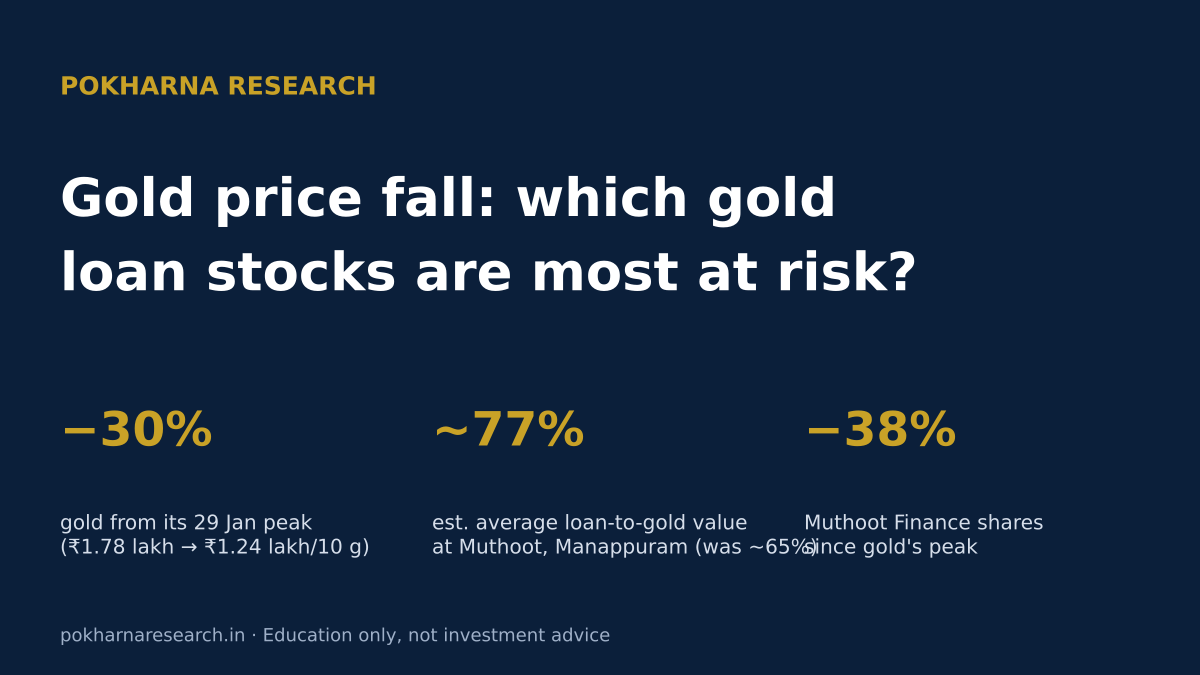
Gold in India more than doubled in 14 months to a peak of about ₹1.78 lakh per 10 grams on 29 January 2026, then fell 30% to ₹1,23,893 on 20 November. Lenders gave out a record ₹3.74 lakh crore of gold loans, up 66% in a year, much of it while gold was expensive. Our estimate: the average gold loan at Muthoot Finance and Manappuram Finance is now about 77% of the gold behind it, up from about 65% in September. The RBI is reportedly asking lenders to watch these loans closely. The companies most exposed are those where gold is most of the loan book; jewellers, on the other hand, have done well.
Gold loans at a glance
Who this is for
- Anyone with a gold loan who wants to know whether the price fall affects them.
- Investors in gold loan companies and banks: Muthoot Finance, Manappuram Finance, IIFL Finance, CSB Bank and others.
- Anyone holding gold or jewellery stocks who wants to understand what a 30% fall changes.
Gold: a huge rise, then a sharp fall
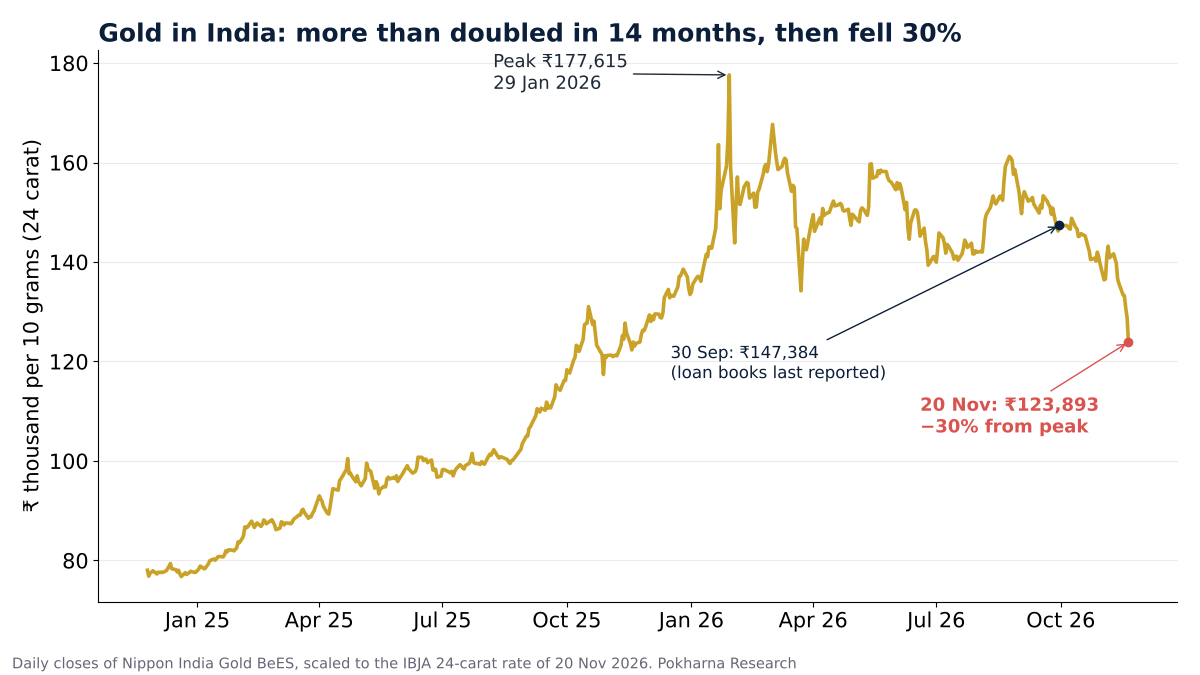
Gold rose from about ₹78,000 per 10 grams in November 2024 to its ₹1,77,615 peak in January 2026. It then traded between roughly ₹1.40 and ₹1.60 lakh for most of the year before falling hard in November, to its lowest level in about a year on 20 November. A stronger US dollar and high US interest rates have weighed on gold worldwide.
Two dates matter for gold loans:
- 30 September, when companies last reported their loan books: gold was about ₹1,47,400.
- 20 November: gold was ₹1,23,893, another 16% lower.
Why a falling gold price hurts lenders
The key number in a gold loan is the loan-to-value ratio (LTV): the loan as a percentage of the gold's value. Under RBI rules in force since April 2026, a lender may lend up to 85% on loans up to ₹2.5 lakh, 80% on ₹2.5–5 lakh and 75% above ₹5 lakh. That cap applies on the day the loan is given. After that, the loan stays the same while the gold's value moves.
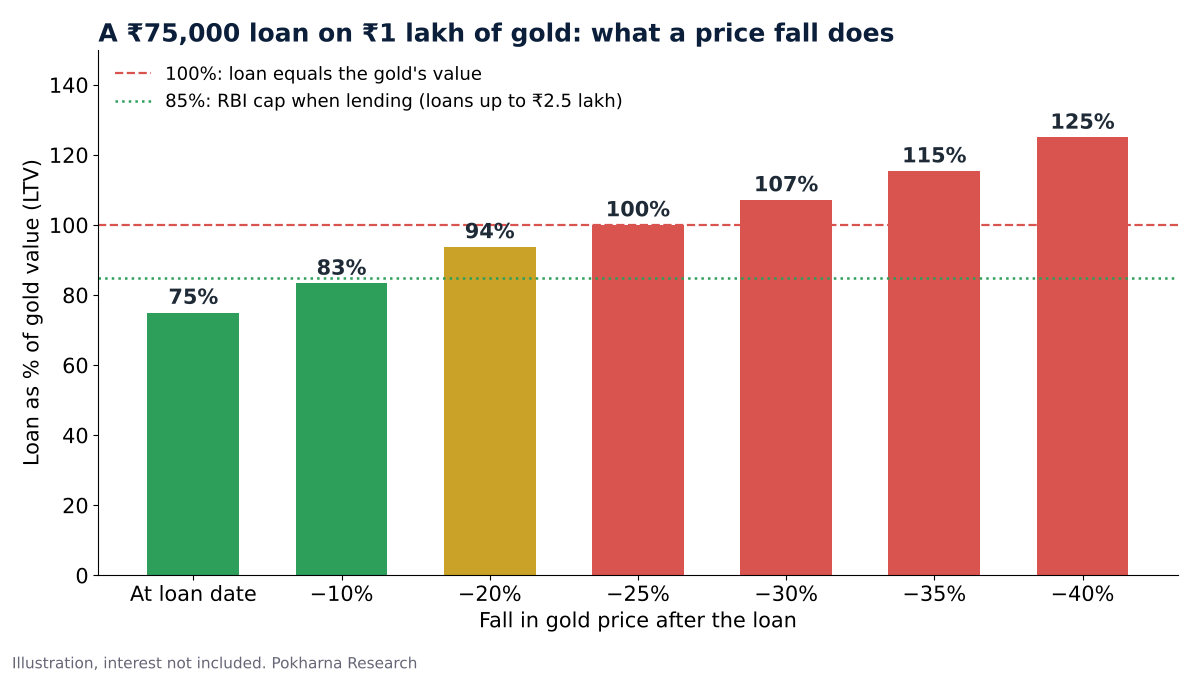
A ₹75,000 loan on ₹1 lakh of gold is safe at 75% LTV. After a 30% fall, the loan is 107% of the gold's value. Reports say some lenders now have individual loans above 100%. That does not mean anyone broke the rules, but if such a borrower stops paying, selling the gold may not recover the loan plus interest.
How thin is the cushion now? Our estimate
Company figures are as of 30 September. We updated them for the 16% fall in gold since then:
| Muthoot Finance | Manappuram Finance | |
|---|---|---|
| Gold loans (30 Sept) | ₹1.79 lakh crore on 204 tonnes of gold | ₹60,640 crore |
| Average LTV, 30 Sept | ~65% | 64.5% |
| Estimated average LTV at 20 Nov gold price | ~77% | ~77% |
For the average loan to equal the gold's value, 24-carat gold would have to fall to roughly ₹95,000 per 10 grams, a level last seen in mid-2025. The average hides a wide range: loans given near the January peak have far less cushion than older loans. At Muthoot, Stage 2 loans already had an LTV of about 72% in September; on the same calculation that is about 86% today.
Which companies are most exposed
| Company | Gold loans (30 Sept) | Share of total loans |
|---|---|---|
| Muthoot Finance | ₹1.79 lakh crore | about 95% (our calculation) |
| Manappuram Finance | ₹60,640 crore | 83% |
| IIFL Finance | ₹65,729 crore, +90% in a year | about 53% (our calculation) |
| CSB Bank | about ₹19,000 crore, as cited by management | about 54% in a recent quarter |
| Bajaj Finance | not a large part | small |
| Large banks (SBI, Federal Bank and others) | large in rupees | a small part of total loans |
Stress signs in the September quarter:
- Muthoot Finance: Stage 2 loans jumped to ₹23,467 crore from ₹1,876 crore in June; the Stage 3 ratio rose to 3.87% from 2.28%; the quarter's impairment charge was ₹515 crore against about ₹51 crore in June.
- Manappuram Finance: gold Stage 2 rose to about 5% from about 0.5%; gold NPA was 1.04%; gold auctions rose to ₹100 crore from ₹13 crore in June.
- Bajaj Finance: gold loans in Stage 2 rose to 4.51% from 0.65% a year earlier.
- IIFL Finance: company-wide gross NPA was 1.5%, slightly lower than in June.
- CSB Bank: the amount of gold pledged fell 6% in a year; the bank plans to bring gold down to about 50% of its loans.
Stage 2 means repayment has slipped but the loan is not yet a non-performing asset (NPA). Stage 3 is roughly the same as an NPA.
Much of the jump in Stage 2 comes from new RBI repayment rules, in force since April 2026, that move many loans from paying everything at the end to regular interest or EMI payments. Muthoot calls the rise "transitional". Manappuram says more than 90% of its gold book is still on end-of-term repayment schemes. Crisil Ratings expects gold loan growth to slow to about 40% in FY27 from 78% in FY26, but does not expect credit losses to rise significantly.
Ranking the impact
- Most exposed: Muthoot Finance and Manappuram Finance. Gold is 80% to 95% of their loans, so a lower gold price affects almost the whole book. Their profits were strong in the September quarter (Muthoot up 36%, Manappuram up 223%), but Stage 2 loans and auctions rose sharply.
- Highly exposed: IIFL Finance and CSB Bank. Gold is about half of their loans; the rest (home loans, MSME, corporate) is not tied to gold.
- Less exposed: Bajaj Finance and large banks. Gold is a small part of their total loans, and bank gold loans are often small farm loans.
- A different story: jewellers. A lower gold price can bring buyers back to jewellery shops, although stock bought at higher prices loses value unless it is hedged.
What the share prices say
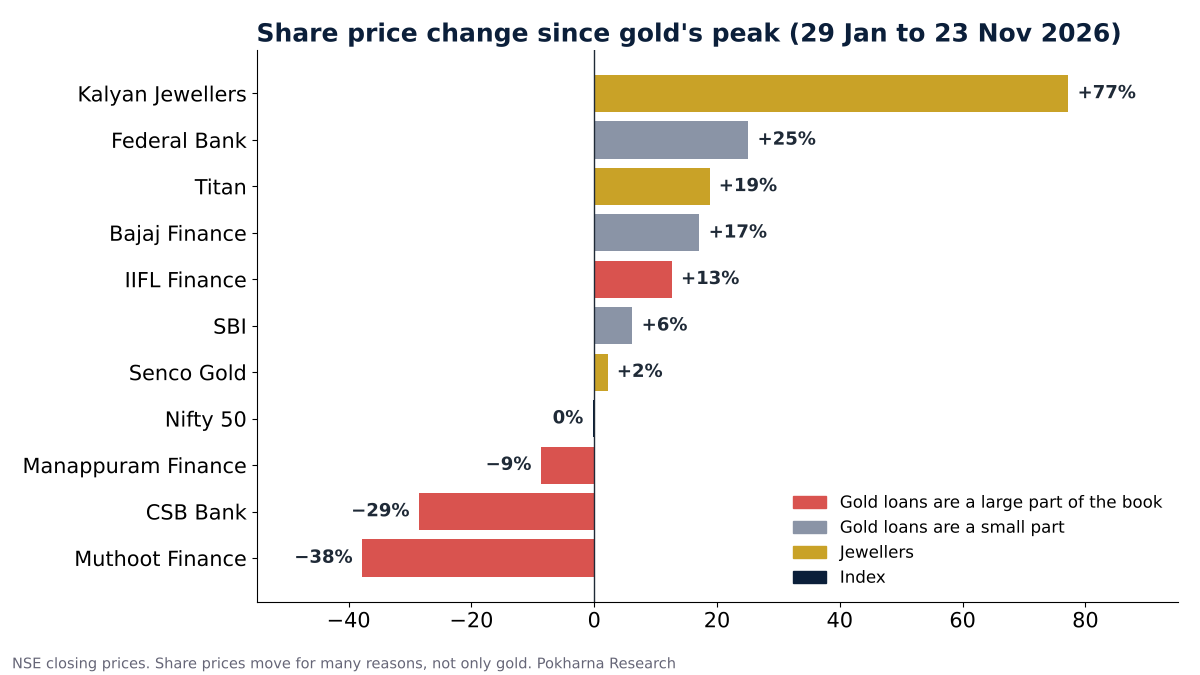
| Company | Close, 23 Nov | Since gold's peak (29 Jan) | 52-week high | 52-week low |
|---|---|---|---|---|
| Muthoot Finance | ₹2,543 | −38% | ₹4,083 (12 Feb), now −38% | ₹2,305 (2 Nov), now +10% |
| CSB Bank | ₹311 | −29% | ₹548 (5 Jan), now −43% | ₹293 (4 Nov), now +6% |
| Manappuram Finance | ₹271 | −9% | ₹382 (30 Jul), now −29% | ₹245 (23 Mar), now +11% |
| IIFL Finance | ₹615 | +13% | ₹705 (24 Aug), now −13% | ₹409 (27 Apr), now +50% |
| Bajaj Finance | ₹1,096 | +17% | ₹1,176 (3 Aug), now −7% | ₹788 (23 Mar), now +39% |
| Kalyan Jewellers | ₹653 | +77% | ₹729 (16 Nov), now −10% | ₹327 (11 Jun), now +100% |
| Titan | ₹4,680 | +19% | ₹5,187 (27 Aug), now −10% | ₹3,751 (9 Dec 2025), now +25% |
| Nifty 50 | 25,350 | 0% |
The market has already separated the two groups. Muthoot and CSB Bank, where gold dominates the book, are down sharply and trade within about 10% of their 52-week lows. Kalyan Jewellers and Titan are up strongly. On 18 November, Muthoot and Manappuram each fell as much as 5% during trading as gold slid. Share prices move for many reasons, so gold is only part of the story.
What the RBI is reported to have done
There is no official RBI circular yet. According to news reports citing people familiar with the discussions:
- In a meeting with NBFC chief executives, the RBI spoke of the need for greater scrutiny of gold loans as falling prices push up LTVs, and cautioned against growing too quickly.
- The RBI has been asking large NBFCs for gold loan data more often than its earlier monthly cycle, over the past 30 to 45 days.
- Separately, gold loan companies have asked the RBI to ease some rules, such as capital requirements and the 100% risk weight on gold loans.
What it means for gold loan borrowers
- Expect calls or messages if your loan's LTV has risen sharply. Lenders may ask you to repay part of the loan or pledge more gold.
- Keep paying interest on time. Overdue loans are checked first, and a long default can lead to the gold being auctioned after notice, under your loan agreement.
- Do the maths: outstanding loan with interest ÷ today's value of your gold. Rates are on our gold and silver rate page.
- Think twice before borrowing more against the same gold. A further fall would widen the gap.
What to watch next
- Gold price: each further 10% fall pushes average LTVs up by several points. See gold, silver and crude today.
- Any official RBI circular on gold loan monitoring, or a response to the industry's requests.
- December-quarter results (January to February): Stage 2, Stage 3 and auction numbers at Muthoot, Manappuram, IIFL Finance and CSB Bank. Dates are on the results calendar.
Which gold loan stocks are most affected by falling gold prices?
Companies where gold loans are most of the book: Muthoot Finance (about 95%) and Manappuram Finance (83%), then IIFL Finance and CSB Bank (about half). For Bajaj Finance and large banks, gold is a small part of total loans.
Why does a fall in gold prices matter for gold loans?
The loan amount stays the same but the pledged gold is worth less, so the loan-to-value ratio rises. If a borrower defaults, selling the gold may not recover the full loan.
What is the RBI's LTV limit for gold loans?
Up to 85% of the gold's value on loans up to ₹2.5 lakh, 80% on ₹2.5 to 5 lakh and 75% above ₹5 lakh, checked when the loan is given (rules in force since April 2026).
Do jewellers gain when gold prices fall?
Often their sales volumes improve as jewellery becomes cheaper, but unhedged stock bought at higher prices loses value. Since gold's January peak, Kalyan Jewellers' shares are up 77% and Titan's 19%.
Has the RBI issued new gold loan rules because of the price fall?
Not as of 24 November 2026. News reports say the RBI has asked NBFCs for closer scrutiny and more frequent data.
This article is educational and informational. It is not investment advice or a recommendation about any security or loan. Estimates are ours and may differ from company figures. Pokharna Research does not claim SEBI registration.
How we did this
- Gold price: daily closes of Nippon India ETF Gold BeES (NSE), scaled to the IBJA 24-carat rate of ₹1,23,893 per 10 grams on 20 November 2026, as a daily series of the Indian gold price.
- Share prices: NSE closing prices to 23 November 2026; "since gold's peak" compares with the close on 29 January 2026; 52-week highs and lows are on a closing basis.
- LTV estimate: September average LTVs from company disclosures as reported, scaled by the fall in gold from 30 September to 20 November.
- Share of gold in loans: our calculation from the reported gold loan and total loan figures where the company did not state it.